Scleral lenses have transformed vision care for patients with keratoconus, irregular corneas, and severe dry eye. Learn how they work and whether they're right for you.
What Are Scleral Contact Lenses?
If you've been told you can't wear contact lenses — or if you've struggled with comfort, vision quality, or dry eye with standard contacts — scleral lenses may change everything.
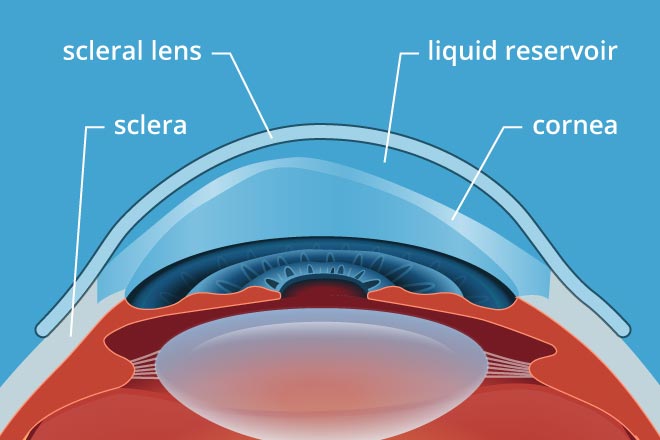
Scleral lenses are large-diameter, rigid gas-permeable contact lenses that vault completely over the cornea and rest on the white part of the eye (the sclera). This design creates a smooth, tear-filled chamber between the lens and the cornea — correcting irregular surfaces and providing continuous moisture throughout the day.
At ProVision Eye Associates in Blue Bell, PA, Dr. Kyle Capel specializes in scleral lens fitting for patients throughout Montgomery County, including Ambler, North Wales, Lansdale, and Plymouth Meeting.
Who Benefits Most from Scleral Lenses?
Keratoconus
Keratoconus is a progressive condition where the cornea thins and bulges into a cone shape, causing distorted vision that glasses and standard contacts cannot adequately correct. Scleral lenses vault over the irregular cornea entirely, providing dramatically sharper, more stable vision.
Post-Surgical Corneal Irregularities
Patients who have had LASIK, PRK, radial keratotomy (RK), or corneal transplants often develop irregular astigmatism that is difficult to correct with standard lenses. Sclerals provide a smooth optical surface regardless of the underlying corneal shape.
Severe Dry Eye Disease
The fluid reservoir beneath a scleral lens acts as a constant source of moisture for the ocular surface — making them a game-changer for patients with severe dry eye, Sjögren's syndrome, graft-versus-host disease, or Stevens-Johnson syndrome.
High Astigmatism and Complex Prescriptions
Patients with prescriptions that are difficult to fit in soft lenses often achieve superior vision with scleral lenses.
Pellucid Marginal Degeneration
Similar to keratoconus, this condition causes peripheral corneal thinning and irregular astigmatism that responds well to scleral lens correction.
What Does the Fitting Process Look Like?
Scleral lens fitting is more involved than a standard contact lens fitting — and for good reason. The fit must be precise to ensure comfort, vision quality, and corneal health.
At ProVision, our fitting process includes:
1. Corneal topography and tomography — detailed mapping of your corneal shape
2. Anterior segment OCT — measuring the vault and landing zone of trial lenses
3. Trial lens evaluation — assessing fit, vision, and comfort with diagnostic lenses
4. Custom lens ordering — lenses are made to your specific measurements
5. Dispensing and training — we teach you insertion, removal, and care
6. Follow-up visits — to fine-tune the fit and ensure long-term corneal health
Most patients require 2–4 visits to achieve the optimal fit.
Are Scleral Lenses Covered by Insurance?
Many vision insurance plans provide some coverage for medically necessary contact lenses, including sclerals for keratoconus. We'll verify your benefits before your fitting appointment and work with your insurance to maximize your coverage.
Schedule a Scleral Lens Consultation in Blue Bell, PA
If you've been struggling with your vision and standard options haven't worked, scleral lenses may be the answer. Call ProVision Eye Associates at (215) 628-2020 or schedule a consultation online. We serve patients from Blue Bell, Ambler, North Wales, Lansdale, Montgomeryville, Plymouth Meeting, and throughout Montgomery County, PA.